_edited.png)


Leadership · Self-awareness · Growth
What Is Emotional Intelligence?
How you understand yourself and how you show up with others matters.
We often think of intelligence in terms of what we know: our expertise, education, analytical ability, and technical skills. But knowing what to do and successfully navigating the human side of work are not always the same thing.
Emotional intelligence (EQ) is the ability to recognize and understand emotions in yourself and others and use that awareness to manage your behavior, relationships, decisions, and responses effectively. EQ shapes how you communicate under pressure, navigate conflict, respond to change, and lead others. Importantly, it can be strengthened through awareness, intentional practice, and feedback.
EQ in everyday leadership
Emotional intelligence becomes especially visible in the moments that challenge us.
A colleague challenges your idea in a meeting.
You need to give difficult feedback.
A team member isn't meeting expectations.
Your organization is navigating significant change.
You're frustrated but need a productive conversation
Someone approaches a problem very differently than you do.
Under pressure, you become impatient, defensive, withdrawn, or overly accommodating.
Work stress keeps you from being fully present with the people who matter.
These situations require more than technical expertise. They require the ability to notice what's happening within yourself, understand what's happening around you, and intentionally choose how you respond. That is emotional intelligence in practice
Understanding Your Emotional Intelligence
I use the EQ-i 2.0®, a validated emotional intelligence assessment published by Multi-Health Systems Inc. (MHS), as one of the tools in my coaching practice. Rather than reducing emotional intelligence to a single number, the EQ-i 2.0 explores a range of interconnected emotional and social competencies across five areas.
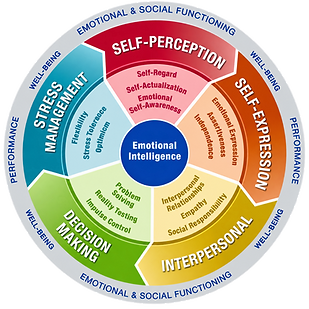
01
Self-Perception
How do I understand myself?
Self-Regard
Self-Actualization
Emotional Self-Awareness
02
Self-Expression
How do I express myself?
Emotional Expression
Assertiveness
Independence
03
Interpersonal
How do I relate to others?
Self-Regard
Self-Actualization
Emotional Self-Awareness
04
Decision Making
How do my emotions influence my decisions?
Interpersonal Relationships
Empathy
Social Responsibility
05
Stress Management
How do I respond to challenge and uncertainty?
Flexibility
Stress Tolerance
Optimism
No perfect profile
There Is No “Perfect” EQ Profile
Emotional intelligence isn't about getting the highest possible score in every area. Different situations require different capabilities. Even a strength can become less effective when it is overused or isn't balanced by other emotional intelligence skills.
01
Empathy + Assertiveness
Empathy helps us understand another person's perspective. Assertiveness helps us communicate on our own. Effective leadership often requires both.
02
Optimism + Reality Testing
Optimism can help a leader see possibility and move forward. Reality testing helps ensure that optimism remains grounded in the facts.
03
Independence + Interpersonal Relationships
Strong leaders need the confidence to think and act independently while also building relationships and remaining open to the perspectives of others.
The value isn't simply in individual scores. It's in understanding how your emotional intelligence skills work together
From Data to Awareness
The assessment doesn't define you. It starts the conversation.
My professional journey began in the sciences, which shaped my appreciation for evidence, research, reliable data, and curiosity. I bring that same orientation to leadership development. Rather than beginning with assumptions about what you should change, assessment gives us a meaningful starting point.
Together, we can ask:
What does the data tell us?
What surprises you?
Where are your strengths?
Where might greater balance be helpful?
How are these patterns showing up in your leadership and relationships?
What would you like to do differently?
What About a 360?
How you see yourself is one perspective. How others experience you is another. For leaders interested in an additional layer of insight, I also use the EQ 360®.
A 360 assessment gathers perspectives from people who experience your leadership such as your manager, colleagues, direct reports, or other professional relationships and allows us to compare those perspectives with your own assessment.
-
Differences between the two aren't necessarily good or bad. They're information.
-
Perhaps you believe you're communicating clearly, but others would benefit from more direction.
-
Perhaps you underestimate a leadership strength that others consistently recognize in you.
-
Perhaps your intention and your impact aren't always aligned.
The goal isn't to determine who is right. It's to become more aware of how your leadership is experienced by others.
.png)
Insight Is Only the Beginning
An assessment can create awareness. Coaching helps turn that awareness into action.
Together, we identify the areas that matter most to you and translate them into specific behaviors you can practice in your everyday work.
My role is to serve as both a thought partner and accountability partner supporting you while also challenging you to experiment, step outside familiar patterns, and put new behaviors into practice
01
Pause before responding under pressure
02
Communicate more directly and assertively
03
Listen with greater curiosity
04
Ask a clarifying question rather than making an assumption
05
Give or receive difficult feedback
06
Recognize an emotional response before it drives your behavior
07
Adapt your communication to different people and situations
08
Remain grounded and intentional during periods of change
%201%20(1).png)
%201.png)
%201.png)
%201.png)
AWARENESS
Understand the pattern
CHOICE
Choose your response
PRACTICE
Practice new behaviors
CHANGE
Create meaningful change

EQ Is Something You Practice
Emotional intelligence isn't about eliminating emotion from leadership. It's about becoming more aware of what is happening within yourself and around you and increasing your ability to respond intentionally.
You don't have to become a different person. You develop a greater understanding of the person and leader you already are—and expand the range of choices available to you.
Greater awareness creates greater choice. Greater choice creates the opportunity for meaningful change.